Guide - Food
Japan food guide: what to eat, what it costs, how to order
Chain meals run from $1 (¥100) to $9 (¥1,420). How a meal works, tipping and tax, dishes by region, markets, dietary needs and drinks.
Japan’s food runs on a few repeatable systems: pay at a machine or the till, queue in order, reserve counter sushi and set menus, and skip the tip. Chain meals run from $1 (¥100) for a conveyor sushi plate to $9 (¥1,420) for a six-piece oyster-fry set, and conveyor sushi starts at $1 (¥100) a plate. This guide covers how a meal works, what it costs, dishes by region, markets, dietary needs and drinks, and each part links to a page with more detail.
What is washoku?
Washoku is the traditional dietary culture of the Japanese, which UNESCO inscribed on its Representative List of the Intangible Cultural Heritage of Humanity in 2013. UNESCO describes it as a social practice of producing, preparing and eating food, based on respect for nature and the sustainable use of natural resources. The inscription stresses New Year, when the practice shows in symbolic dishes and rice cakes, and notes that families and schools pass it on.
At a restaurant, the everyday form is the set meal (teishoku). JNTO describes its layout: rice at front left, soup at front right and side dishes behind.
How does a meal work in Japan?
How you order depends on the kind of shop, and the first step is often to pay or to put your name on a list. Ordering food in Japan covers each step in detail. The essentials:
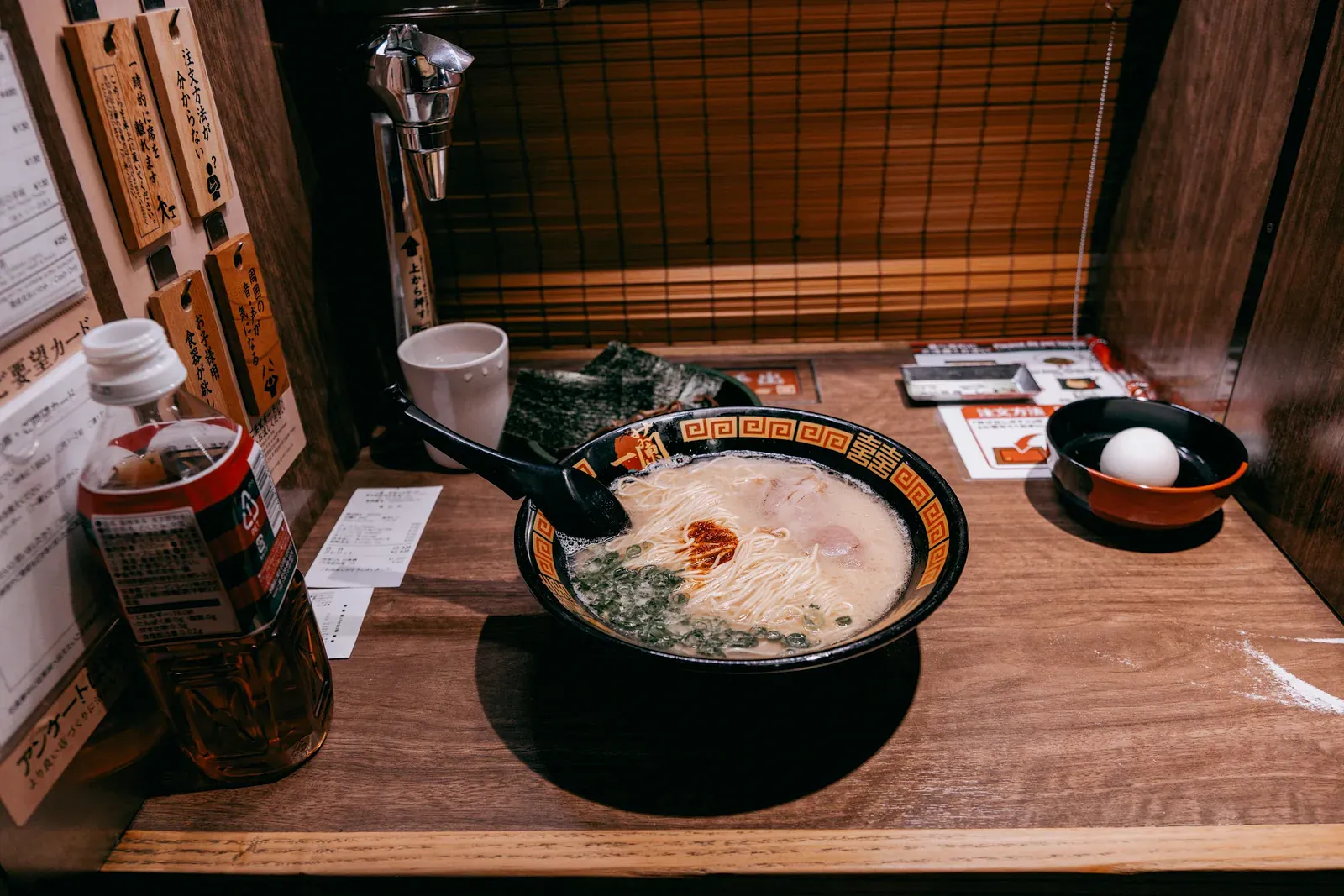
- Ticket machines. At many ramen shops you pay first at a machine. Insert money, press the buttons for noodles, drinks and sides, take your change, hand the printed ticket to staff and sit. Some shops take orders from staff instead. Payment varies by store: Ichiran’s English store page lists QR codes, cards and IC cards at its machines and notes that machines can be down for maintenance, so do not assume cash only or card only.
- Queues and lists. Queues are orderly and nobody cuts ahead, so follow the signs and floor markers. Some restaurants keep a list at the entrance where you write your name, party size and seat type, counter or table. Chains, family restaurants and ramen shops are usually first come, first served. Ramen is a quick meal, so do not linger when people queue outside.
- Reservations. Popular downtown areas often need one. Many restaurants have foreign-language booking pages. For Japanese-only sites use browser translation, and for phone-only restaurants a hotel concierge or travel agent can call. Some services ask you to reconfirm 24 to 48 hours ahead, with times in Japan Standard Time. Some venues take a card or deposit and keep it for a no-show or late cancellation, and some limit table time, often to about 2 hours.
- Otoshi. An izakaya brings a small dish automatically. It works as a table charge, it is not free, and you cannot choose or swap it. Tell staff about diet needs at once. Table charges are shown on the menu or signs, and staff can explain them. JNTO gives no amount. Torikizoku, a yakitori chain, says it charges no otoshi, seat or late-night charge.
- Sushi. On a conveyor belt, lift plates off, do not return them, and read the price from the plate colour. Tea is usually self-serve, and counter seats order from the chef. At a counter, dip the topping, not the rice, in soy sauce. Ginger between pieces cleans the palate, and eating by hand is fine. JNTO says omakase bookings are a must and same-day walk-ins are hard.
Never stand chopsticks upright in rice or pass food from chopsticks to chopsticks. Slurping noodles is fine. Pour drinks for others, not yourself, and hold your glass while it is poured.
Before you book Reserve omakase and set-menu meals ahead and arrive on time, because set menus are served together. Cancel early if plans change, since some venues keep a deposit for a no-show.
What does food cost?
A chain meal costs $1 to $9 (¥100 to ¥1,420), and food and drink took 21.9% of visitor spending in 2025.
| Meal | Chain price | Detail |
|---|---|---|
| Beef bowl | $3 (¥480) | Sukiya regular since 8 July 2026; mini $3 (¥420), large $4 (¥680); price may differ by store |
| Set meal | $6 to $9 (¥890 to ¥1,420) | Yayoiken, tax included: ginger-pork $6 (¥890) in April 2026, chicken nanban $6 (¥990), oyster-fry set $7 (¥1,120) for 4 pieces or $9 (¥1,420) for 6, new from 2 October 2026 |
| Ramen | $6 to $8 (¥980 to ¥1,180) | Ichiran classic tonkotsu, by branch; extra noodles $1 (¥210), rice $2 (¥300); some pages old, tax status not stated |
| Conveyor sushi | From $1 (¥100) a plate | JNTO floor; Sushiro lean tuna $1 (¥150) since 22 July 2026, salmon, squid and shrimp from $1 (¥120); Kura Sushi lowest plate $1 (¥110) since 4 September 2026 |
Dollar figures use about ¥155 to US$1 and are rounded; you pay in yen, so check the rate.
Chain prices move: Sukiya raised its regular beef bowl in July 2026, Sushiro repriced some plates in July and Kura cut its lowest plate in September. Check the menu on the day.
The Japan Tourism Agency’s 2025 survey puts food and drink at 21.9% of visitor spending, third after lodging at 36.6% and shopping at 27.0%. Per visitor that is about $325 (¥50,000) per trip, while one table in the annual report shows $290 (¥44,989), and the definitions differ between breakdowns. No per-day figure was found, so treat both as a guide to last year, not a budget.
JNTO’s sushi guide gives no yen price for omakase, and no official price list for market food turned up, so none is given here. What a meal costs has the full price ladder.
Do you tip, and how does tax work?
Pay the amount on the bill. JNTO says tipping is not common in bars, cafes, restaurants, taxis or hotels and is not expected, so thank staff aloud instead. If a guide or interpreter is used to overseas practice, JNTO says to tip discreetly in an envelope. Whether some restaurants add a service charge is not confirmed; JNTO’s tipping page does not mention one.
Eating in carries 10% consumption tax. Takeout and delivery food carry the reduced 8%, per the National Tax Agency’s reduced-rate tables (medium confidence). Alcohol is always 10%. The 10% splits into 7.8% national and 2.2% local, and the 8% into 6.24% and 1.76%. Menus show tax-included prices.
Cards are usually accepted at urban restaurants, hotels and big stores, while small shops, cafes and rural areas may be cash only. Visa, JCB and Mastercard are the most widely accepted. Apple Pay, Google Pay and Alipay sometimes do not work, and some local QR apps do not support foreign phones, so carry cash. Tipping and paying covers both.
Which dishes belong to which region?
Sushi, ramen, tempura, yakitori and kaiseki turn up across Japan, and each region adds its own dishes. JNTO describes the five in its guides.
- Sushi is vinegared rice (shari) with a topping (neta) of seafood, egg or vegetables. JNTO says it does not simply mean raw fish, and it is eaten at every price level, from izakaya to refined counters.
- Ramen is egg noodles in chicken or pork-bone broth flavoured with salt, soy or miso, with toppings such as chashu, nori, egg and vegetables. JNTO names Sapporo miso and Hakata pork-bone as regional styles.
- Tempura, yakitori and kaiseki are covered in the table below. Kaiseki runs from starter and clear soup to simmered dish, sashimi, grilled dish, rice and dessert.
Okonomiyaki is a savoury cabbage pancake. Osaka style mixes cabbage, flour and egg and griddles it, while Hiroshima style layers its ingredients and includes noodles. Okonomiyaki: Osaka vs Hiroshima compares them.
Kobe Beef is a registered geographical indication (number 3 on MAFF’s register). The Kobe Beef Marketing and Distribution Promotion Association says it comes only from Tajima-gyu cattle, a heifer or steer born and raised in Hyogo. The carcass must score 6 or higher on the marbling scale (BMS), reach yield grade A or B and a meat quality score of 4 or above, graded by the Japan Meat Grading Association, with a carcass weight up to 499.9 kg. Kobe beef and wagyu has the detail.
MAFF’s Our Regional Cuisines portal lists local dishes by prefecture; seasons are not stated. In Tohoku, Miyagi’s best-known local dish is harako-meshi, rice with salmon and roe, alongside zunda-mochi from Sendai and aburafu-don from the north. In Chubu, Nagano is listed for oyaki dumplings, and Fukui’s page covers heshiko, preserved fish. In Kyushu, Kumamoto’s list includes yubeshi, a yuzu sweet, and honekajiri, bone-in simmered meat from Hitoyoshi and Kuma, and Kagoshima’s includes kibinago sashimi. In Okinawa, iyachi is a preserved glutinous-rice food from Taketomi Island in the Yaeyama group. No MAFF dish list was found for Hokkaido, Kanto, Shikoku or Kansai. For those, JNTO covers Sapporo miso ramen and Osaka-style okonomiyaki, and the Kobe Beef association covers Kobe Beef.
A secondary travel guide ties hotpots (nabe) to places. Ishikari-nabe in Hokkaido is salmon in a miso broth built on kombu, kiritanpo-nabe in Akita is chicken with pounded-rice tubes, and motsu-nabe in Fukuoka is offal with chilli in a soy or miso dashi. Chanko-nabe, the sumo staple, clusters around Ryogoku in Tokyo, and yudofu, tofu in a kombu broth, is easiest to find in Kyoto. Oden, which is daikon, egg, konnyaku and fishcake simmered in broth, is a winter favourite and is also sold in convenience stores. For crab, read Sapporo crab hotpot; the season dates conflict between guides, so none are given.
Dish and region table
The table pairs each dish with its region and, where a chain page gave one, a price.
| Dish | Region | What to know |
|---|---|---|
| Sushi | Nationwide | Vinegared rice with a seafood, egg or vegetable topping, not only raw fish; conveyor plates from $1 (¥100) |
| Ramen | Nationwide | Egg noodles in chicken or pork-bone broth; Sapporo miso and Hakata pork-bone are named styles; $6 to $8 (¥980 to ¥1,180) at one chain |
| Tempura | Nationwide | Seasonal vegetables or seafood in light batter, dipped in soy-based broth with grated radish |
| Yakitori | Nationwide | Charcoal-grilled chicken skewers, seasoned with salt or sweet sauce |
| Kaiseki | Nationwide | Seasonal multi-course meal from starter to dessert |
| Set meal | Nationwide | Rice, soup and sides; ginger-pork and chicken nanban are chain examples at $6 to $9 (¥890 to ¥1,420) |
| Beef bowl | Nationwide | Mini, regular and large sizes at Sukiya; regular is $3 (¥480) |
| Ishikari nabe | Hokkaido | Salmon hotpot in a miso broth built on kombu |
| Harako-meshi | Miyagi | Rice with salmon and roe; the best-known local dish |
| Kiritanpo | Akita | Pounded rice on a cedar stick, grilled with miso or put in a chicken hotpot |
| Oyaki | Nagano | Dumplings listed by MAFF |
| Heshiko | Fukui | Preserved fish listed by MAFF |
| Okonomiyaki | Osaka, Hiroshima | Cabbage pancake; Osaka mixes the batter, Hiroshima layers and adds noodles |
| Yudofu | Kyoto | Tofu in light broth; easiest to find in Kyoto |
| Kobe beef | Hyogo | Tajima-gyu, BMS 6 or higher, registered geographical indication |
| Motsu-nabe | Fukuoka | Offal hotpot with chilli, in a soy or miso dashi |
| Honekajiri | Kumamoto | Bone-in simmered meat from Hitoyoshi and Kuma |
| Kibinago | Kagoshima | Kibinago served as sashimi |
| Iyachi | Okinawa | Preserved glutinous-rice food from Taketomi Island |
Which food markets can you visit?
Check each market’s own calendar first, because hours and closed days differ by market and by shop. Food markets covers each one.
| Market | City | Hours | Closed or rule |
|---|---|---|---|
| Toyosu | Tokyo | 5:00 to 17:00; shops and restaurants keep their own hours | Sundays, public holidays and other closure days; closed 31 December to 4 January in 2025-26 |
| Tsukiji Outer | Tokyo | Each shop sets its own; 9:00 to 14:00 is the official advice for the public | Many shops closed Sundays and some Wednesdays |
| Kuromon | Osaka | Per shop; examples include 8:00 to 17:00 and 11:00 to 23:00 | Many shops close one weekday or Sunday, some 1 to 4 January |
| Hakodate Morning | Hakodate | 5:00 to 14:00, varying by store | No holiday |
| Nijo | Sapporo | Shops 7:00 to 18:00, restaurants 6:00 to 21:00 | Hours differ by shop; busiest 8:00 to 11:00 |
Toyosu’s 2026-27 closure calendar is not confirmed, so check the official calendar. The tuna auction runs roughly 5:30 to 6:30. Observation-deck viewing needs advance online registration for 5:45 to 6:25, on opening days only, and the rules change by month. Without registration you can watch from the second-floor visitor passage. At Uogashi Yokocho, tourists are encouraged to come from 8:00.
At Tsukiji Outer Market, trade buyers shop from 6:00 to 9:00. Smoking is banned on Chuo-ku streets outside designated areas, large suitcases and strollers do not suit the narrow lanes, and you should ask shopkeepers before taking photos.
Kyoto City Tourism asks visitors to avoid eating while walking at Nishiki Market: eat in front of the shop where you bought or take food home. It is one of the market’s core rules, and a request, not a ban. In Kanazawa, Omicho’s official site is Japanese only, and the market is a 15-minute walk from the east exit of Kanazawa Station. Market-wide hours and closed days for Nishiki and Omicho were not found.
How do you eat with dietary needs?
Name the ingredient you avoid, and say so when you book, because JNTO says not all places show allergy information. The mandatory allergen labelling rule applies to packaged processed food.
Allergies
The Consumer Affairs Agency lists nine mandatory allergens on packaged food labels: shrimp or prawn, crab, walnut, wheat, buckwheat, egg, milk, peanut and cashew. Its page records cashew as added on 1 April 2026, and walnut was added on 9 March 2023. The agency shows its list as an image, so the nine are the earlier eight plus cashew. The transition period for product labels is not confirmed, so a label may not show cashew yet.
A separate recommended list is voluntary. Almond joined it on 19 September 2019 and macadamia on 28 March 2024, when matsutake came off. “Processed on the same line” notes are voluntary and sit outside the ingredient list, per the Tokyo Metropolitan Government. The agency page applies the rule to packaged processed food and states no duty for dining out. Tokyo also publishes an allergen communication sheet in Japanese, English, two Chinese scripts and Korean, aimed at restaurants and usable at the table. The Food allergy card lists the nine.
Safety Tell staff about an allergy when you book or sit down, before you order. A packaged item with no cashew declaration is unconfirmed, not proof that it is cashew-free.
Vegetarian and vegan
Ask for no meat, seafood or animal products, including dashi. JNTO says fish stock (bonito) is a common hidden item, and packaged natto sauce often contains dashi. Name the animals too: clarify chicken, pork and fish. Carry a Japanese card, tell set-menu venues at booking and tell ryokan in advance, since JNTO says simply requesting vegetarian may not be enough.
Secondary travel guides add that kombu and shiitake stock are plant-based while katsuobushi, niboshi and mixed stock are fish, and that bonito flakes top tofu, okonomiyaki and takoyaki. In convenience stores, umeboshi and kombu rice balls are usually available, plus edamame, salads and inarizushi.
Shojin ryori is traditionally vegan and leaves out garlic and onion. It is served mainly at temples and temple lodgings (shukubo), and modern monks sometimes use dairy, so ask ahead. A JNTO experience page says some temples offer overnight stays with shojin meals, bookable up to 5 days ahead. Eating vegetarian and vegan in Japan has more.
Halal, kosher and gluten
JNTO publishes a Welcome Guide for Muslim Travelers covering mosques, prayer facilities, dining and hotels, with regional guides from Hokkaido to Okinawa. Japan has no central halal agency, per JNTO’s Muslim travel pages (medium confidence), and Muslim-friendly is not a defined level. Halal-friendly restaurants may not have a separate halal kitchen, and mirin and cooking sake are common, so check ingredients.
No official kosher guidance and no official Japanese gluten labelling guidance was found. Wheat is a mandatory allergen, so it shows on packaged labels, and secondary travel guides say soy sauce contains wheat. Halal and kosher in Japan covers what exists.
What should you know about drinks?
The legal drinking age is 20. Adulthood fell to 18 on 1 April 2022, but the limit for drinking and smoking stayed at 20, per the Ministry of Justice.
Drinking outdoors is not illegal nationally, and hanami picnics are normal, per JNTO’s local-laws page. Another JNTO page advises against drinking on the street or outside a convenience store, which may bring police attention or fines, and local bylaws are unclear. News reports (secondary) in 2024 described a Shibuya ward ordinance banning drinking in streets and parks from 18:00 to 05:00 since 1 October 2024, without a fine. Its 2026 status is unclear right now.
For sake, the Japan Sake and Shochu Makers Association sorts bottles into special-designation sake (tokutei meisho-shu) and regular sake (futsu-shu). The percentages below are the share of the rice grain left after polishing.
- Daiginjo and junmai daiginjo: 50% or less, with koji rice at 15% or more.
- Ginjo and junmai ginjo: 60% or less.
- Tokubetsu junmai and tokubetsu honjozo: 60% or less, or a special method.
- Honjozo: 70% or less, with added brewer’s alcohol up to 10% of the polished rice weight.
- Junmai: rice, koji and water only, with no polishing minimum.
Honkaku shochu is single-distilled by a traditional method from natural ingredients, and Okinawa’s version is awamori. Per the National Tax Agency, awamori holds the geographical indication Ryukyu, uses rice koji made with black koji (Aspergillus luchuensis) and a pot still, and is called kusu when aged 3 years or more. The techniques arrived more than 500 years ago.
Japanese whisky has a voluntary industry standard from the Japan Spirits and Liqueurs Makers Association, set in February 2021 and fully in force from April 2024. It requires saccharifying, fermenting and distilling in Japan, a distillate under 95% alcohol by volume and at least 3 years in wooden casks of 700 litres or less in Japan, and it allows caramel colour. It binds members only, and a geographical-indication application to the National Tax Agency was planned for early 2026; the result is unclear right now. The details come from a Japanese-language summary, not the official text.
Two distillery visits have winter dates. Nikka’s Yoichi tour in Hokkaido is free, runs about 70 minutes, takes 1 to 9 people and is by reservation only, with walk-ins refused. The distillery is closed 23 December to 7 January. Suntory’s Yamazaki museum needs a reservation, and its paid tour is by lottery; the last known price is $19 (¥3,000) from October 2023, and the current price is unclear right now. Sake and drinking in Japan goes deeper.
Where next?
Read Sapporo crab hotpot for a winter dinner and the culture guide for etiquette and festivals. Kobe beef and wagyu and Okonomiyaki: Osaka vs Hiroshima cover two dishes in depth, and the Food hub lists every food page.
Quick answers
How much does a meal cost in Japan?
Chain meals run from $1 (¥100) for a conveyor sushi plate to $9 (¥1,420) for a six-piece oyster-fry set. Ramen at one chain is $6 to $8 (¥980 to ¥1,180), and conveyor sushi starts at $1 (¥100) a plate. No official price for omakase or market food was found.
Do you tip in Japan?
No. JNTO says tipping is not common in restaurants, bars, cafes, taxis or hotels, and is not expected. Thank staff aloud instead, and pay the amount on the bill.
How do ticket machines work?
Insert money, press the buttons for noodles, drinks and sides, take your change and hand the printed ticket to staff, then sit down. Some shops order through staff instead, and card or QR payment at the machine varies by store.
Can I eat vegetarian or vegan in Japan?
Yes, with planning. Fish stock (dashi) is a common hidden item, so ask for no meat, seafood or animal products including dashi, and carry a Japanese card. Tell set-menu venues at booking and ryokan in advance.
Do restaurants have to list allergens?
The mandatory allergen rule covers packaged food, and the agency page states no duty for dining out. The list has nine items, cashew included. Tell staff your allergen when you book, because JNTO says not every place shows allergy information.